

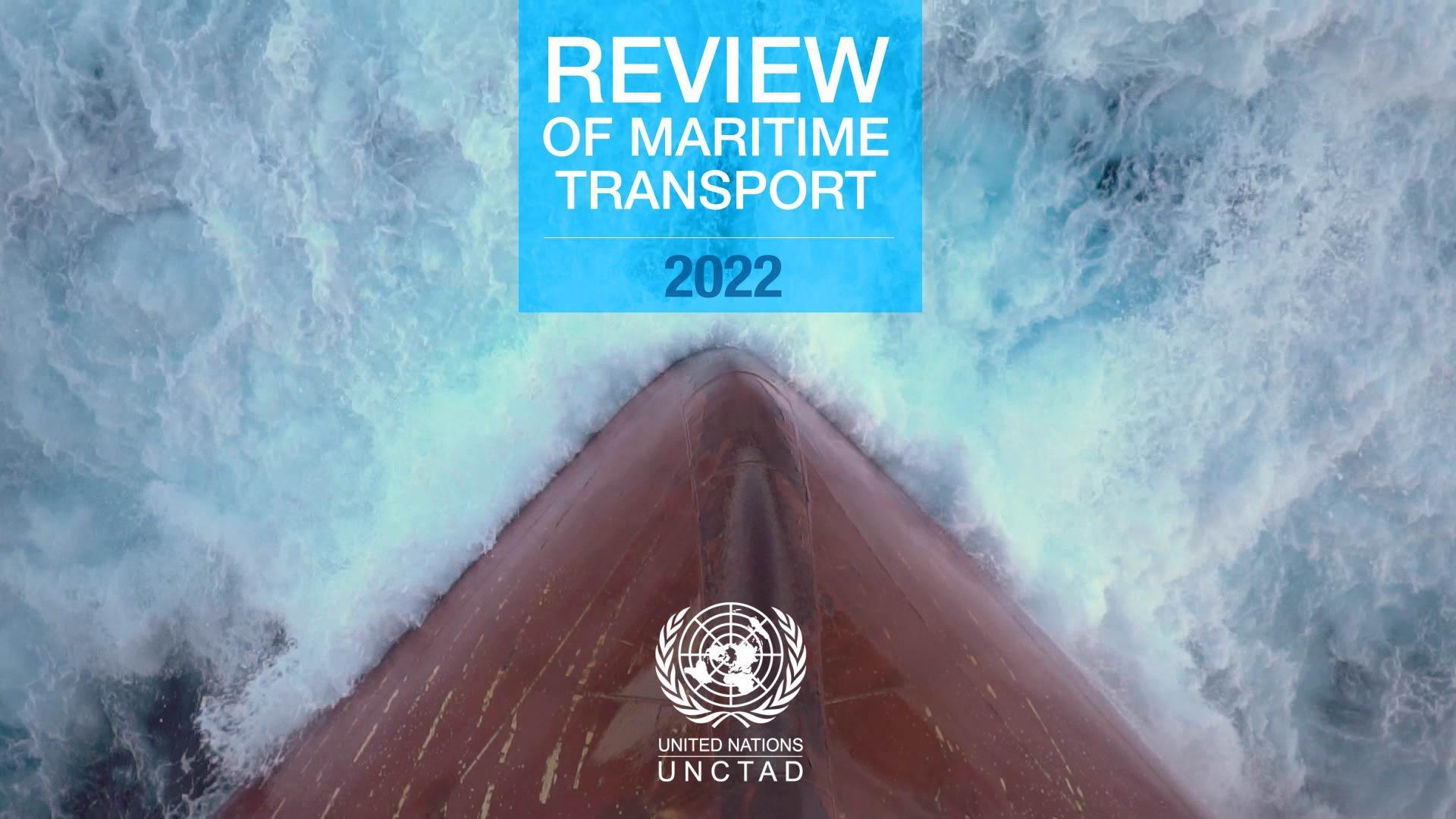
The Review of Maritime Transport is an UNCTAD flagship report, published annually since 1968. It provides an analysis of structural and cyclical changes affecting seaborne trade, ports and shipping, as well as an extensive collection of statistics from maritime trade and transport.
UNCTAD in its “Review of Maritime Transport 2022” also published “Facts and Figures on Africa” which are as follows:
Trends in maritime trade
In 2021, Africa’s maritime trade, including both goods loaded and discharged, amounted to 1.3 billion tons, a 5.6% increase over 2020. The continent accounted for 6.9% of total goods loaded and 5% of total goods discharged.
In 2021, containerized South-South trades, such as Sub-Saharan Africa to Latin America and the Caribbean, accounted for 12.5%, and North-South, such as Africa to Europe, for 7.8%.
In 2021, labour strikes affecting ports and the logistics sector in South Africa contributed to further supply chain disruptions that were a key feature of the recovery in 2021 and 2022.
Freight rates
Spot freight rates also surged across routes in developing regions. Between December 2020 and December 2021, on the Shanghai to South Africa (Durban) route the rate per 20-foot-equivalent unit (TEU) increased from $2,521 to $6,450, and on the Shanghai to West Africa (Lagos) route from $5,291 to $7,452.
To address problems in the more profitable lanes, shipping carriers withdrew capacity and empty containers from the smaller trade routes – with corresponding knock-on effects. In Africa, for example, between July 2020 and July 2021 average capacity fell by 6.5%. This contributed to the increase in container freight rates, with one-way China-to-Africa rates increasing from $2,000–$2,500 to $4,000–$5,000 per TEU. For Asia to Cameroon, the rate for 20-foot containers increased by 340%, and for 40-foot containers by 244%.
Performance indicators
In Sub-Saharan Africa, port calls for container ships fell steeply. This was partly a knock-on effect of port congestion in main trading lanes – through late arrivals of vessels and container shortages, combined with COVID-19-related restrictions on workforces. In addition, carriers removed some shipping capacity in order to service routes in Eastern Asia and Northern America.



Despite a six-day blockade of the Suez Canal in March 2021, Northern Africa recorded stable growth in container ship port calls, supported by ongoing development and upgrading of ports, including Tanger Med in Morocco and Ain Sokhna in Egypt. Between 2019 and 2021, container ship port calls in Tanger-Med increased from 2,652 to 3,195, and in Ain Sokhna from 59 to 217. On the other hand, port calls in Port Said – one of the largest ports in the region – decreased from 3,516 to 3,393.
The World Bank and S&P Global released the updated Container Port Performance Index (CPPI 2022), which assesses and aggregates vessel turnaround time within 10 narrow call size ranges and five vessel size ranges. The second version for 2021, released in May 2022, revealed that Sub-Saharan Africa was one of the regions with the lowest rankings. Meanwhile, Northern Africa saw an improvement, driven by Damietta Port in Egypt, whose ranking jumped from 297 to 58 due to a new multipurpose terminal installed in 2019 that reduced vessel waiting time.
In terms of capesize dry bulk cargo handling performance, countries in West Africa (Guinea and Sierra Leone) had performances lower than the global average.
As regards performance in cargo handling involving very large crude carriers (VLCC), Western African economies like Angola, Cameroun, Gabon and Equitorial Guinea showed average or higher performances, while others – Nigeria and Ghana – had low performances.
For Handysize tankers, Tunisia and Algeria performed well, while the Republic of the Congo, Gabon, Togo and Nigeria showed low performances.
Between the third quarter of 2020 and the second quarter of 2022, the Liner Shipping Connectivity Index (LSCI) for Africa declined from 18.8 to 17.6. As shipping lines reassigned ships to the China-US routes, some states in Africa lost deployed capacity: South Africa and Republic of the Congo by 16 %.
Some hub countries in Africa increased vessel capacity. Deployed capacity in Morocco increased by 32.5 %, mostly driven by the ongoing development of Tanger Med.
Over the past decade the largest increases in CO2 emissions included those by a Liberian-flagged vessel (33%). In 2021, the flag states emitting the most CO2 included Liberia.
Fleet and ship supply
As of 1 January 2022, the top three flags of registration in terms of dead-weight tonnage and commercial value included Liberia. The Liberian flag registered the highest increase in the share of fleet value – 2.2 percentage points.
Africa is the region with the oldest bulker, container ship and oil tanker fleets. It also has many old bulk carriers.
African fleet ownership is limited. Despite efforts over many years to increase African participation in the supply of shipping services, the continent still relies mostly on foreign-owned vessels. Compliance with environmental regulations and competitiveness could make African ownership even more difficult, and along some routes the continent may also face the higher costs associated with the deployment of greener ships. Several countries with well-developed transport infrastructure and the potential to supply alternative energy, such as South Africa, Egypt and Morocco, are already planning for bunkering greener ships.
Source: UNCTAD